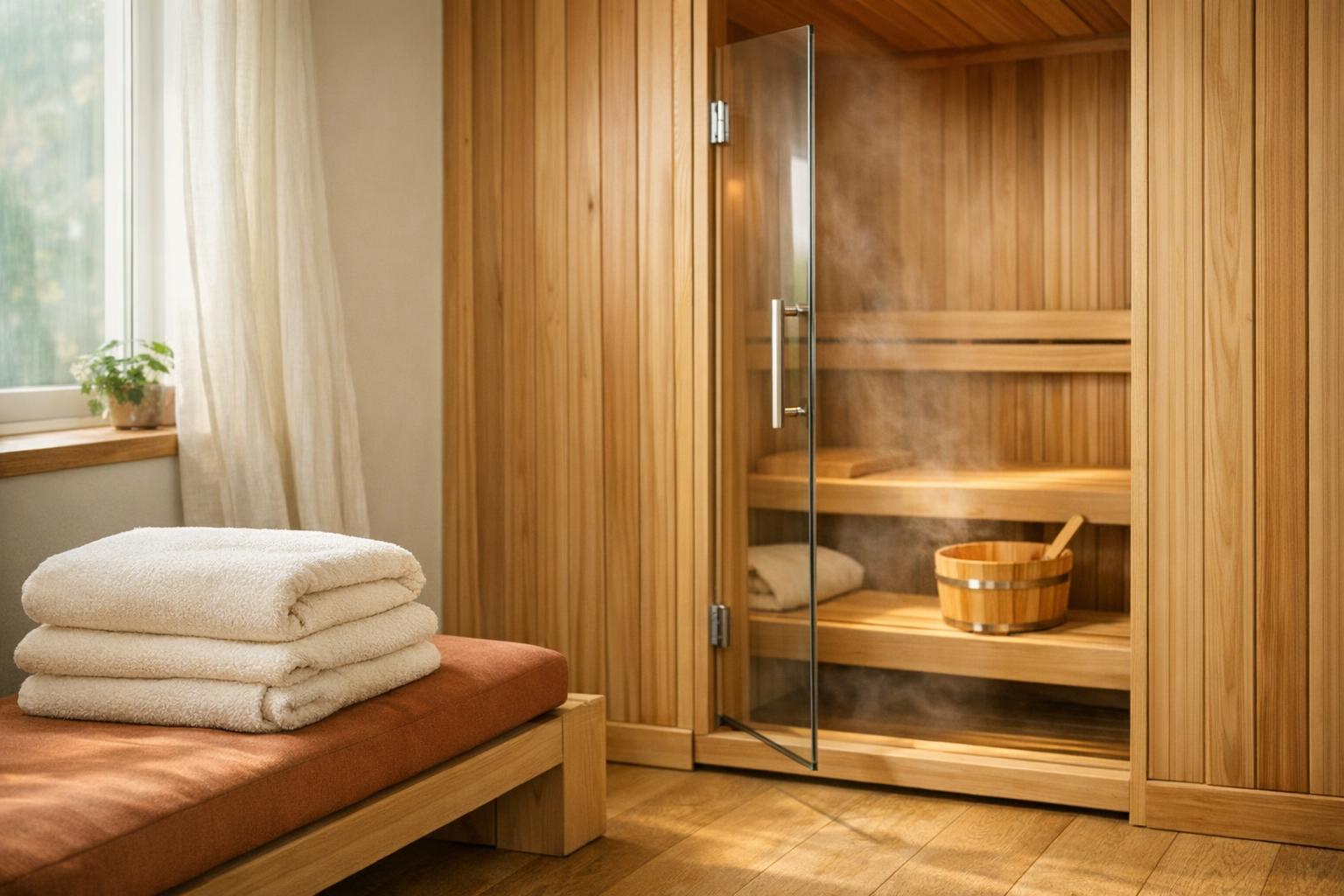
Most home sauna purchases go wrong in the same place: the buyer picks a cabin they like, then discovers it does not fit the room, the doorway or the outlet that was supposed to run it. Choosing well is mostly a measuring exercise, done before you open a single product page. This guide walks the order we would follow — room first, capacity second, panel type and materials last — and shows which of those answers a listing can actually give you.
Start with the room, not the cabin
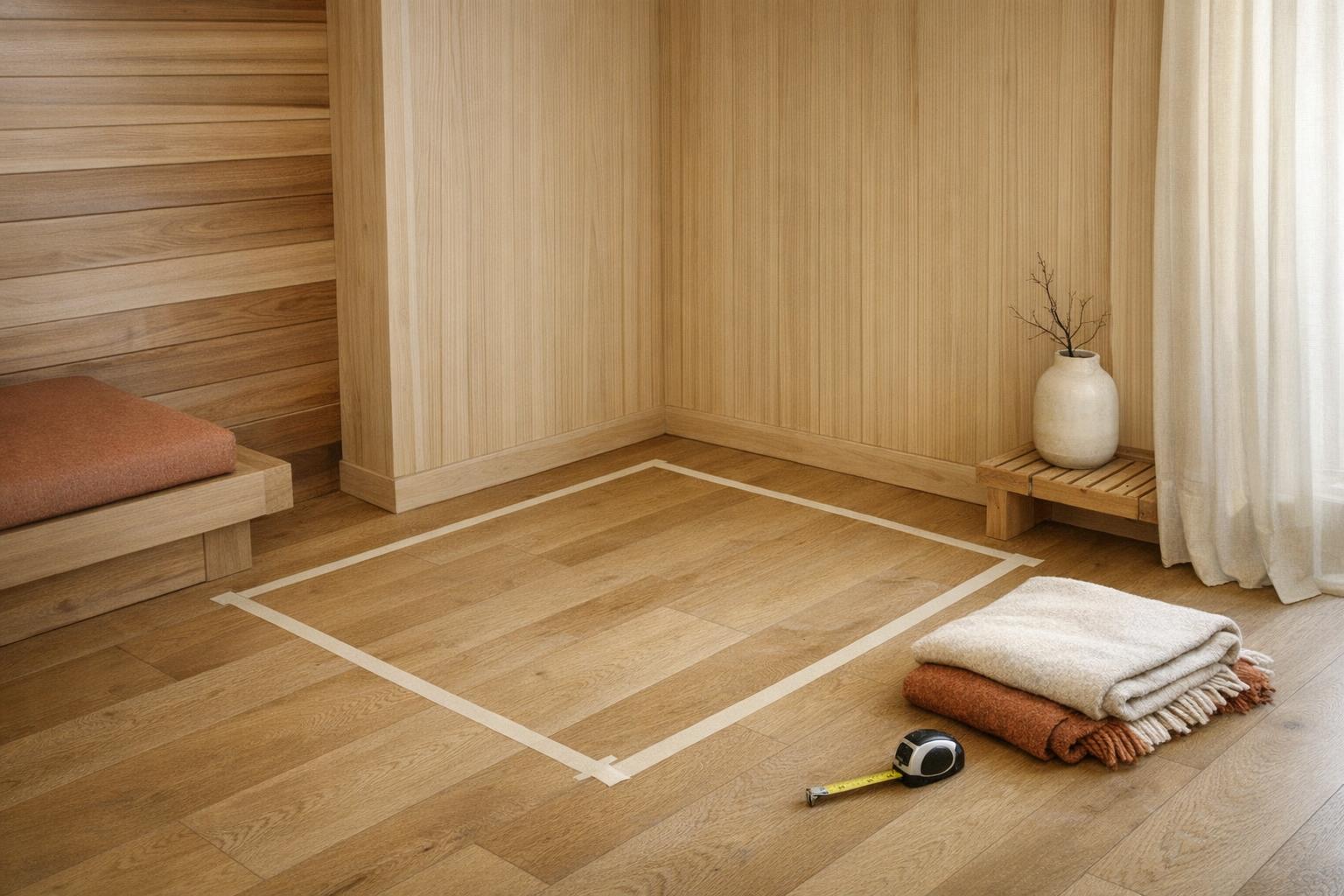
The constraint that decides your purchase is the floor you can permanently give up. A two-person wood cabin occupies roughly four feet by three and a half feet of floor, and it does not move once assembled. Measure the wall you intend to use, then measure the clear space in front of the door swing, then measure the narrowest point on the route from your front door to that wall — hallway corners defeat more sauna deliveries than stairs do.
Write those three numbers down before you shop. Every listing states an assembled size; most state a packed carton size too, and the carton is what has to make the turn. Our sauna size planner takes your floor width and depth and tells you which documented capacity band fits with clearance around it, which is faster than doing the arithmetic per listing.
Ceiling height matters less than people expect — most cabins land between 70 and 77 inches — but a basement with ductwork or a sloped attic wall can still rule out a unit that would otherwise be ideal.
Capacity is a footprint class, not a promise
A listing that says "2 person" is telling you about bench length, not about comfort. Two adults in a two-person cabin sit shoulder to shoulder with no room for a towel between them; two people who want space usually buy the three-person size. If you are the only regular user, a one-person cabin saves a remarkable amount of floor and is the honest choice for most apartments.
In our catalog, capacity is the single attribute we require before a listing can earn a documented spec-fit score, because it is the one figure that is stated plainly and consistently in listing titles. Where it is absent we fall back to a documentation-completeness score and label the card accordingly — the methodology page spells out both formulas.
Browse by capacity band rather than by brand: the two-person comparison is where most first-time buyers end up, and the full cabin collection shows what the other bands look like.
Panel type and wood: what the listing documents
Two spec words recur across these listings. "Far infrared" describes panels emitting in the long-wave band; "full spectrum" describes units that add near and mid emitters, usually at a higher price. Our panel type guide treats both strictly as documented equipment specifications — what the seller states the hardware is, nothing about what it does to anyone.
Cabin wood is usually Canadian hemlock, sometimes cedar, occasionally spruce. Hemlock is the volume default and is close to odorless; cedar carries its own scent that some owners specifically want and others specifically do not. Neither is a quality ranking — they are different materials at different prices, and the listing tells you which one you are buying.
- Panel type: stated as far-infrared or full-spectrum in the listing text.
- Wood: hemlock, cedar or spruce, named in the title or bullets.
- Glass: most cabins use tempered glass doors; thickness is often stated in millimetres.
- Controls: LCD panels, Bluetooth audio and chromotherapy lighting are common extras that affect price more than footprint.
Check the outlet the listing asks for
Every cabin listing states a voltage and often an amperage. Smaller units run from a standard 120V household outlet; larger ones state a 20-amp dedicated circuit or 240V service. This is not a detail to discover after delivery, because the difference between "plugs in" and "needs an electrician" is usually several hundred dollars.
Read the exact figure on the exact listing — sellers of similar-looking cabins state different requirements — and if it is anything other than a standard outlet you already have, get a quote before you buy. Anything beyond plugging into an existing standard household outlet — a new circuit, a new receptacle, any change to your wiring — belongs to a licensed electrician. We publish what the listing states and stop there. Our voltage guide explains how to read those lines without turning them into installation advice.
A short buying order that works
- Measure the wall, the door swing clearance and the narrowest point on the delivery route.
- Pick a capacity band from the space that survives step one — not from how many people you hope will use it.
- Filter to wood cabins or fabric portables depending on whether the unit can stay assembled.
- Read the stated voltage and confirm you have that outlet, or price an electrician.
- Compare panel type, wood and controls last; they change price far more than they change fit.
If any step produces a no, it is cheaper to find out at step one. When you are ready, the cabin versus fabric comparison is the fastest way to see how differently these two product classes are documented.