The line on a sauna listing that most often turns a purchase into a project is the one describing power. Some cabins plug into any household outlet. Others state a dedicated 20-amp circuit or 240V service that your room may not have. This guide is about reading those lines correctly before you buy. It is not installation guidance, and it deliberately stops short of telling you how to change anything in your home.
The three requirement tiers you will see
Across this catalog, sauna listings describe their power needs in one of three ways, and the difference between them is the difference between an evening and a contractor.
- Standard household outlet. Stated as 110V or 120V with a normal plug. Most fabric portables and smaller one- and two-person cabins fall here. If the outlet exists and is not already loaded, this plugs in.
- Dedicated 120V 20-amp circuit. Common on larger two- and three-person cabins, often stated alongside a wattage figure near 1,800 to 2,000 W. The plug may look familiar, but the listing is asking for a circuit that serves this appliance alone.
- 240V service. Stated on the largest cabins. This is a different receptacle entirely and is never something you already have in a spare bedroom.
In our catalog, a voltage figure appears on a minority of listings, and where it does we store the exact quoted text with its source. Where it is absent, the honest answer is that we do not know and neither do you until you ask the seller.
Where to find the figure and what it looks like
The voltage line is usually in the feature bullets rather than the title, frequently in the same sentence as heating time or panel count: "1890W, 120V, 20 Amp" is a typical fragment. Some sellers put it only in a specification image, which means it will not appear in any text search — worth knowing if a listing seems to omit it entirely.
Read the exact listing you intend to buy. Two visually identical cabins from different sellers routinely state different requirements, and a figure copied from a review or a competing listing is not evidence about yours.
If the listing states nothing, ask through the product question section before ordering. A cabin that arrives needing a circuit you do not have is an expensive return.
What "dedicated circuit" is asking for
A dedicated circuit means the appliance is the only thing on that breaker. The reason listings ask for one is straightforward: a cabin drawing close to 16 amps continuously shares a 20-amp circuit badly with anything else, and a tripped breaker mid-session is the polite failure mode.
Whether you have one, and what it would cost to add one, are questions for a licensed electrician who can look at your panel. Anything beyond plugging into an existing standard household outlet — a new circuit, a new receptacle, any change to your wiring — belongs to a licensed electrician. We publish what the listing states and stop there. We will not tell you which breaker to check, how to identify a circuit or what wire is involved, because that guidance does not belong on a product comparison site.
Budgeting for the answer
If the cabin you want states a dedicated circuit or 240V and you do not have one, get a quote before ordering. Electricians can price that work from a photo of your panel and the run distance in most cases, and knowing the number changes which cabin makes sense.
This is also a genuine argument for the smaller cabin or for a fabric portable: a unit that runs from an outlet you already have has no second invoice attached. The cabin versus fabric guide weighs that trade, and the cabin collection lets you compare stated requirements across listings.
Extension cords and the one rule worth repeating
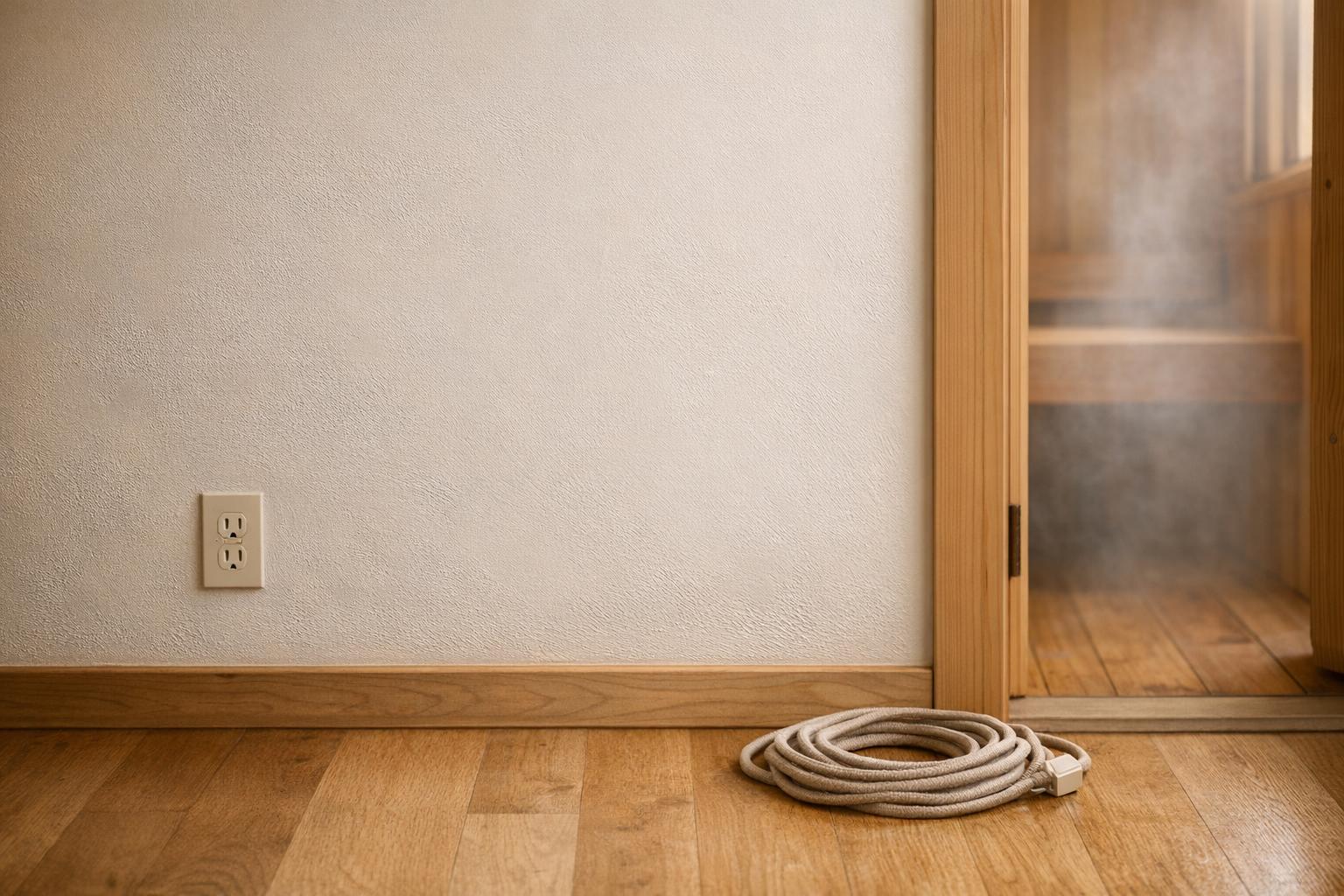
The question every sauna forum answers badly is whether you can run a cabin from an extension cord. Manufacturer manuals for these units are close to unanimous in saying no, and that instruction is the one to follow — not because we have an opinion about your wiring, but because the manufacturer wrote it about their appliance.
If the outlet is in the wrong place, the fix is to move the sauna or to have an electrician address the outlet. It is not to bridge the gap with hardware the manual excludes. This is the same reasoning we apply to every electrical question on this site: the manual and a licensed professional decide, and we do not.
One more line worth reading on the listing: continuous versus peak draw. Cabin listings state a wattage figure that is usually the maximum with every panel calling for heat, which happens during preheat rather than throughout a session. It is still the figure the circuit has to carry, so treat the stated maximum as the requirement.
The same applies to adapters that change a plug pattern to fit a receptacle it was not made for. A plug that physically fits is not evidence that the circuit behind it suits the load, and no product page — ours included — can tell you otherwise about your home.